
INTRODUCTION TO ADDITIVE MANUFACTURING
What is Additive Manufacturing?
Additive Manufacturing or 3D printing (commonly called) is a process that creates a physical object from a digital design. There are different 3D printing technologies and materials you can print with, but all are based on the same principle: a digital model is turned into a solid three-dimensional physical object by adding material layer by layer.
It is important to point out from the beginning that Additive Manufacturing does not constitute a single technology but a set of manufacturing processes, very different from each other, that share three common characteristics.
1. They are manufacturing processes by addition of material to construct a solid three-dimensional object.
2. The object is constructed by superimposing successive layers of material.
3. The object is made from a digital 3D model.

They are called ADITIVE Manufacturing processes to differentiate them from conventional processes. Together with these, they are part of the set of processes available to the industry.
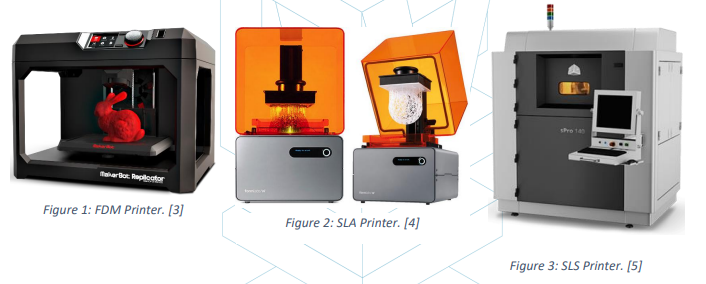
Some of the most used additive manufacturing technologies that best suits to the educational area will be described in the following point of this guide. These technologies are: Fused Deposition Modeling (FDM), Stereolithographic (SLA) and Selective Laser Sintering (SLS).
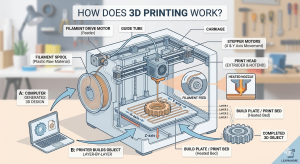
How does 3D printing work?
It all starts with making or obtaining a virtual design of the object you want to create. This
virtual design can be made in a CAD (Computer Aided Design) file using a 3D modeling program
(for the creation of a totally new object) or with the use of a 3D scanner (to copy an existing
object). A 3D scanner makes a 3D digital copy of an object. There are also lots of online file
repositories where you can download existing 3D files that will help get you started.
The 3D printing process turns an object into many, tiny little slices, then builds it from the
bottom up, slice by slice. The layers then build up to form a solid object.

The full process is explained in the point 3 of this guide.
Some advantages of Additive Manufacturing compared to conventional processes
Fewer steps between the CAD model and the production of the part.
- Generally, few human resource requirements due to a high level of automation.
- A large number of geometrical forms can be manufactured, enabling for instance the
production of parts which are topologically optimised, with internal channels, etc. - High-speed manufacturing for small, complex parts.
- Generally, less material wastage.
- Possibility to reconstruct damaged sections of existing objects, depending on the part
material - No special tooling required.
What is Rapid Prototyping?
Rapid prototyping is an automated process that quickly builds physical prototypes from 3D
CAD files composed of surface quality or solid models. Any manufacturing process can be
classified as either subtractive, formative or additive. Every manufacturing process either falls
completely into one of these categories or is a hybrid process falling into more than one. In
the manufacturing arena, productivity is achieved by guiding a product from concept to
market quickly and inexpensively. Rapid prototyping technology aids this process.
It is important not to confuse rapid prototyping with 3D printing or with additive
manufacturing, because the concepts are used interchangeably and wrongly many times. We
can say that additive manufacturing is one of the technologies with which we can produce a
rapid prototyping product.
It is convenient to underline that every technology and every process has a starting point in
common: computer aided design (CAD).
Here some of the most common techniques for Rapid Prototyping:
- 3D Scanner / Reverse Engineering.
- Additive Manufacturing.
- CNC Machining.
- Vacuum Fast Casting.
- Prototype Moulds.
- Sand Casting.
- Investment Casting.
The purpose of rapid prototyping is to test the various design features, ideas, concepts,
functionality, output and performance.
TECHNOLOGIES
In order to identify the most suitable 3D printing technologies for educational purposes, the
following table was developed. It presents a comparison between a total of 7 technologies,
which are the most used currently, according to the latest trends. The analysis was based on
12 parameters, which are considered the best ones in order to have a full overview on what
3D printing offers. Special focus was given to strengths and weaknesses for each technology
as they are important indicators in the identification.
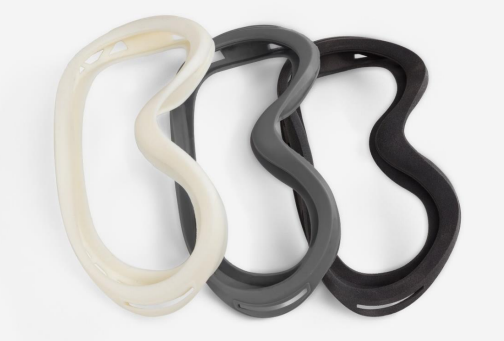
Through the study carried out in the report IO1 / A3: Identification of 3D printing most suitable
technologies for education, the consortium identified the three printing technologies
described below as the most recommended for use in the educational field. Here, in addition
to the Process, Materials, Application Areas, the Strengths and Weaknesses are also described
for each one of them.
Key Benefits of Additive Manufacturing
Industries like aerospace, automotive, and healthcare utilize additive manufacturing because it offers unique competitive advantages:
- Design Freedom: Engineers can design complex, lightweight geometries—such as organic lattices—that reduce weight without sacrificing strength.
- Zero Material Waste: Since material is only placed where needed, raw material waste is reduced by up to 90% compared to traditional machining.
- Rapid Prototyping: A digital design change can be tested physically in a matter of hours, vastly accelerating product development timelines.
- Toolless Production: Eliminating the need for custom molds or specialized cutting tools makes low-volume production runs financially viable.
- On-Demand Logistics: Companies can store digital blueprints in the cloud and print spare parts locally, drastically reducing physical inventory costs and supply chain delays.
The Seven Categories of Additive Manufacturing
The American Society for Testing and Materials (ASTM) officially classifies additive manufacturing into seven distinct technical processes:
- Material Extrusion (e.g., FDM): Material (usually plastic filament) is pushed through a heated nozzle to trace layers. This is the most common approach for basic prototyping.
- Vat Photopolymerization (e.g., SLA, DLP): A liquid resin sits in a vat and is selectively cured (hardened) by a light source like a UV laser or projector. It delivers exceptionally high surface detail.
- Powder Bed Fusion (e.g., SLS, SLM/DMLS): A thermal source (like a laser or electron beam) selectively fuses regions of a fine powder bed (plastic, ceramic, or metal).
- Material Jetting: Similar to an inkjet 2D printer, this machine drops droplets of photopolymer material onto a build plate, which are immediately cured by UV light. It allows for multi-colour and multi-material printing.
- Binder Jetting: A liquid bonding agent is selectively deposited onto a powder bed to glue the particles together layer by layer. The parts are later baked in a furnace to achieve full strength.
- Direct Energy Deposition (DED): A nozzle mounted on a multi-axis robotic arm deposits metal wire or powder while simultaneously melting it with a laser or electron beam. It is primarily used to repair existing high-value parts.
- Sheet Lamination (e.g., LOM): Sheets of material (paper, plastic, or metal foil) are bonded together layer by layer using adhesive or ultrasonic welding, and then cut into shape by a laser or knife.
https://shorturl.fm/jQxj2
https://shorturl.fm/VRfxe