
FUSED DEPOSITION MODELING (FDM)
Process, Materials, Application Areas
Home printers typically work with plastic filament. The technology behind this is often
referred to Fused Deposition Modeling (FDM) is a 3D printing technology that works by
extruding a thermoplastic polymer through a heated nozzle which gets deposited on a building
stage. FDM is also considered to be a form of additive manufacturing, which at the same time
is a “process of joining materials to make objects from 3D model data, usually layer upon
layer”.
Creating a 3D printed object through FDM requires, in the first place, to work on a STL file
(stereo lithography file format) which mathematically slices and orients the model for the next
building process. Sometimes, the software is capable of generating support structures for the
object automatically. In general, the machine requires materials for both the object and the
support.
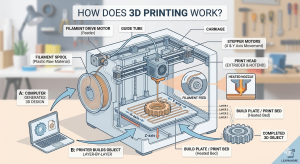
The mere process involves a plastic filament which is fed by a spool to the nozzle were the
material is liquefied and “drawn” on the platform. As soon as it touches the build stage, the
that the printer is able to start working on the next layer.
filament hardens while being gradually deposited, following a certain structure, in order to
create the final 3D print. When a layer is drawn, the platform lowers by one layer thickness sothat the printer is able to start working on the next layer.

There are many different materials which can be used with FDM. In the first place, they are
divided between the industrial and the consumer categories. The most commonly used are
ABS (Acrylonitrile Butadiene Styrene), PLA (Polyactic Acid) and Nylon (Polyamide), but other
exotic varieties of materials can also be used, like a material blend of plastic and wood or
carbon.
Because this technology presents some very good pros, FDM is often used in the area of non
functional prototypes in order to produce concept parts, functional models, prototypes in
general, manufacturing tooling and modeling, and end use parts. More specifically, FDM can
be used for low-volume production and prototypes aimed at form, fit and function tests.
At the same time, it is most commonly used in the aerospace sector, for example, to produce
wind turbines. Anatomical models for medical use are also very much suitable to be built with
this technology. Finally, FDM has slowly been enabling the rapid prototyping of biomedical
micro devices, the kind of devices that are used on a daily basis in hospitals, for example,
therefore very much fundamental, as it is considered both cheap, but at the same very safe.
Since 2004, FDM technology has been used in a particular sector to produce load-bearing
scaffold, which, according to a study, “has the potential for osteochondral defect repair”.
Strengths and Weaknesses
When it comes to 3D printing technology, one of the very first concerns relate to its cost. While
in general it is the long-term use of materials that can become a serious expense, those who
want to engage with Fused Deposition Modeling have an advantage from the start; in fact,
FDM printing machines are among the cheapest and most affordable especially for those who
want to use it in a domestic environment. Many brands today are available pre-built like
Maker Bot and Ultimaker, two of the most popular desktop 3D printers, or can be built using
DIY kits or going from the grounds up and printing parts to create a 3D printer.
Always on a positive side, FDM is considered to be a very clean technology, usually simple-to
use and office-friendly. The technology can also produce complex geometries and cavities that
would otherwise be quite problematic.
As for accuracy, the 3D prints do not reach the same level of accuracy and quality of other
items which are instead produced through the use of Stereolithograpy. That said, the result is
considered to be fairly qualitative, depending on the sector where the technology is applied.Resolution depends mainly on the size of the nozzle that is used. The precision of the machine
is dependent on the extruder movements on the X and Y axis, but there are other factors to
be taken into consideration. For example, the bonding force between the layers is lower than
in the Stereolithography process. Consequently, the weight of the layers might squeeze the
lower layers, which can therefore influence and even compromise the quality of the 3D print.
Contrary to SLA, FDM presents also an increased complexity. One needs to keep in mind
weight and size, but also constraints. It is very important to make sure that a print can meet
the expectations that one sees on the screen when first modelling. The constraints in this case
depend on several factors, but mainly on the material chosen, through which it is possible to
understand how big an item can be printed through FDM.


How the FDM Process Works
The FDM printing cycle relies on three-dimensional movement and precise thermal control:
- Material Feeding: A spool of raw plastic string (filament) is pulled into the print head by a motorized gear system called an extruder.
- Melting: The filament enters a hot end, where a heating block melts the plastic into a semi-liquid state.
- Layer Tracing: The melted plastic is pushed through a tiny nozzle (typically 0.4mm wide). Guided by G-code, the print head moves along the horizontal X and Y axes, drawing the first layer of the object onto a heated build platform.
- Fusing: The plastic cools and hardens almost instantly upon leaving the nozzle, bonding to the surface below it.
- Stepping Up: Once a layer is finished, the Z-axis moves (either the bed drops or the print head rises) by one layer height—usually between 0.1mm and 0.3mm. The process repeats until the object is complete.
Common FDM Filament Materials
FDM machines are highly versatile because they can print with a wide variety of thermoplastics, each offering unique physical properties:
- PLA (Polylactic Acid): Made from cornstarch, it is biodegradable, very easy to print, and produces no toxic fumes. It is the default choice for beginners, visual models, and rapid prototypes.
- PETG (Polyethylene Terephthalate Glycol): A middle ground between PLA and ABS. It is chemically resistant, durable, and slightly flexible, making it ideal for functional outdoor parts.
- ABS (Acrylonitrile Butadiene Styrene): A tough, heat-resistant plastic used in LEGO bricks. It requires an enclosed printer because it shrinks and warps as it cools, and it releases pungent fumes during printing.
- ASA (Acrylonitrile Styrene Acrylate): Similar to ABS but highly resistant to UV radiation and weather, making it the industry choice for automotive exterior parts.
- TPU (Thermoplastic Polyurethane): A rubber-like, highly flexible material used to print gaskets, phone cases, and wearable items.
- Engineering Grades (Nylon, Polycarbonate, PEEK): Used in industrial FDM machines for high-stress aerospace, chemical, and mechanical applications requiring extreme strength and heat tolerance.
Advantages and Limitations of FDM
Pros:
- Cost-Effective: FDM printers and filament spools are significantly cheaper than resin or metal alternatives.
- Material Variety: A single machine can print rigid, flexible, heat-resistant, or even wood-infused plastics just by swapping the spool.
- Minimal Mess: Unlike resin printing, there are no liquid chemicals to wash, cure, or handle.
- Scalability: FDM machines can scale from small desktop units up to massive industrial systems capable of printing large structural components.
https://shorturl.fm/VPC3n
https://shorturl.fm/FsiX6
https://shorturl.fm/5YRPx