
FUSED DEPOSITION MODELING (FDM)
FUSED DEPOSITION MODELING (FDM) Process, Materials, Application Areas Home printers typically work with plastic filament. The technology behind this is…
FUSED DEPOSITION MODELING (FDM) Process, Materials, Application Areas Home printers typically work with plastic filament. The technology behind this is…

How Does 3D Printing Work? 1. 3D Modeling Software Modeling is the first step of 3D printing. Manufacturing companies typically…
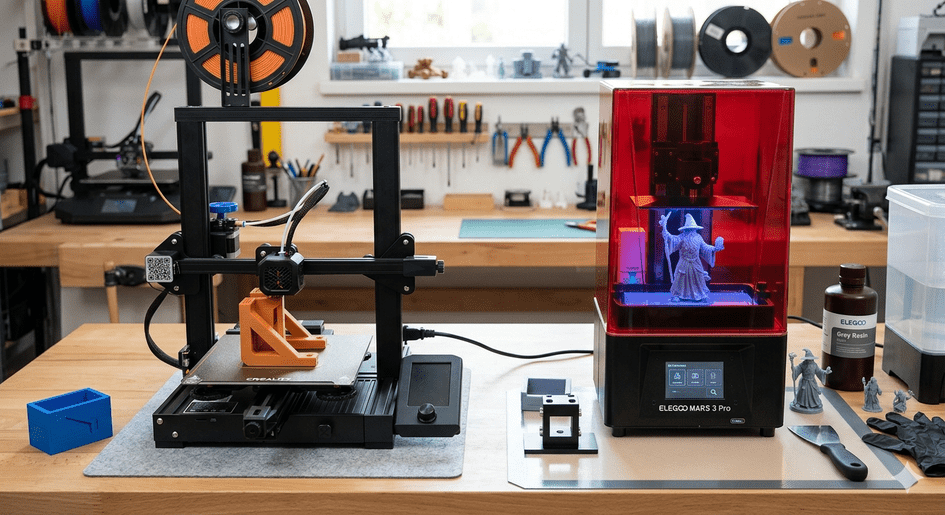
FUSED DEPOSITION MODELING (FDM) 3D printing is a specific 3D printing technology that falls under the broader additive manufacturing category of “material extrusion”. As the name implies, any machine falling under this category extrudes material in specific patterns to produce a final shape, with FDM using molten plastic (sometimes combined with other materials) as its extrusion medium.
FDM works very similarly to a hot glue gun: A solid strand is pushed into a hot nozzle that melts it and allows it to flow and be laid down in flat layers. In the case of a printer, these movements within a layer are accurately directed along (for the most part) the X- and Y-axes of a Cartesian coordinate system. The first layer is deposited on a print surface, cooling and solidifying quickly. Another layer is then added on top of the last one, and the process is repeated, building a 3D object slowly, layer by layer.
is the most common, cost-effective 3D printing technology, utilizing thermoplastic filaments (PLA, ABS, PETG) extruded through a heated nozzle layer-by-layer. It is ideal for rapid prototyping, functional parts, and hobbyist projects due to its speed, versatility, and ease of use.

Types of 3D Printing Technologies and Processes 1.Vat Photopolymerisation a.Stereo lithography (SLA) b.Digital Light Processing (DLP) c.Continuous Liquid Interface Production…
Recent Comments