FDM 3D printing
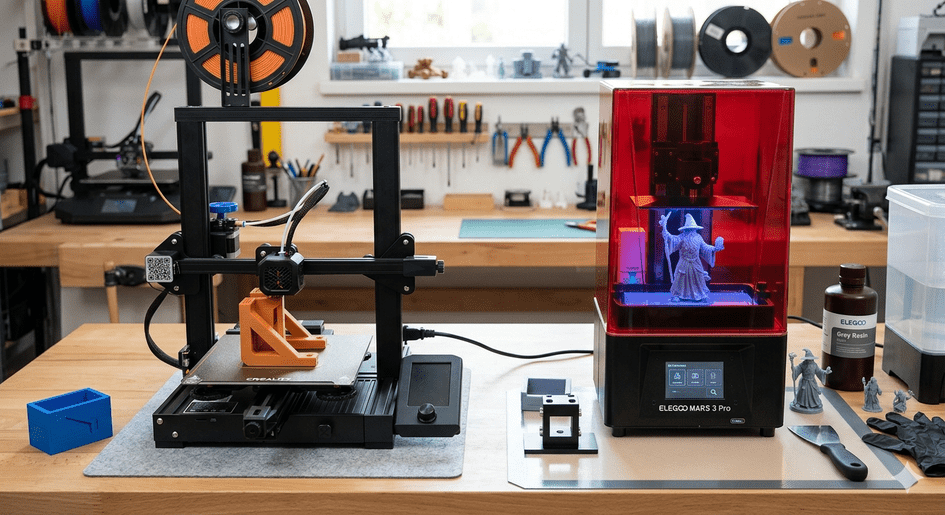
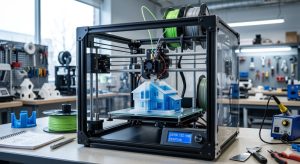
FUSED DEPOSITION MODELING (FDM) 3D printing is a specific 3D printing technology that falls under the broader additive manufacturing category of “material extrusion”. As the name implies, any machine falling under this category extrudes material in specific patterns to produce a final shape, with FDM using molten plastic (sometimes combined with other materials) as its extrusion medium.
FDM works very similarly to a hot glue gun: A solid strand is pushed into a hot nozzle that melts it and allows it to flow and be laid down in flat layers. In the case of a printer, these movements within a layer are accurately directed along (for the most part) the X- and Y-axes of a Cartesian coordinate system. The first layer is deposited on a print surface, cooling and solidifying quickly. Another layer is then added on top of the last one, and the process is repeated, building a 3D object slowly, layer by layer.
is the most common, cost-effective 3D printing technology, utilizing thermoplastic filaments (PLA, ABS, PETG) extruded through a heated nozzle layer-by-layer. It is ideal for rapid prototyping, functional parts, and hobbyist projects due to its speed, versatility, and ease of use.
Key Aspects of FDM FUSED DEPOSITION MODELING (FDM) 3D Printing
- Process: A filament is fed through a heated extruder, melting the material, which is then deposited on a build platform according to a CAD model.
- Layer-by-Layer: Each deposited layer fuses to the previous one as it cools.
- Materials: Common materials include PLA (easy to print), ABS (durable/strong), PETG (functional), and composites like carbon fiber.
- Applications: Commonly used for prototyping, manufacturing tools, automotive parts, and consumer products.
- Design Limitations: FDM typically has a 0.8 mm minimum wall thickness and requires support material for overhanging structures.
Advantages
- Cost: Low cost for both machines ($250–$2,000 for desktop) and materials.
- Speed: Ideal for rapid, on-demand, and low-volume production.
- Variety: Wide range of thermoplastic materials available.
Disadvantages
- Surface Finish: Often shows visible layer lines, requiring post-processing (sanding, polishing) for a smooth finish.
- Accuracy: Lower accuracy and tolerance compared to SLS or SLA (typically
, with a lower limit of
- Anisotropy: Parts are generally weaker in the vertical direction (z-axis).
Resin printers
Resin printers are 3D printers that use liquid photopolymer resin and a light source (usually UV) to build objects layer by layer. They are primarily used for high-detail projects like miniatures, jewelry, and dental models.
How They Work
The printing process follows these basic steps:
- Vat Filling: A reservoir is filled with liquid, light-sensitive resin.
- Curing: A build plate lowers into the resin, and a light source (laser, projector, or LCD) hardens a thin layer of liquid in a specific pattern.
- Layering: The plate lifts, fresh resin flows underneath, and the next layer is cured on top of the previous one until the model is complete.
- Post-Processing: Prints must be washed in isopropyl alcohol (IPA) to remove excess liquid and then cured under additional UV light to fully harden.
Choosing a Resin Printer
When selecting a printer, prioritize these factors based on your goals:
- Printer Type:
- MSLA (LCD): The most common and affordable for beginners. They use an LCD screen to cure entire layers at once.
- SLA: Uses a laser to draw each layer; highly precise but typically more expensive and slower.
- Resolution (XY Resolution): Focus on pixel size (measured in microns) rather than just “4K” or “8K” labels. Smaller pixel sizes (around 20–30 microns) result in finer details.
- Build Volume:
- Small (6–7″): Best for individual miniatures; more budget-friendly.
- Medium/Large (10″+): Better for batches of models or larger display pieces.
- Smart Features: For a smoother experience, look for auto-leveling build plates, heated vats (for consistent curing in cold rooms), and resin level sensors.
Recommended Models (2024–2026)
- Best for Beginners: Elegoo Mars 5 (~₹15,000–₹18,000) for simplicity and reliability.
- Best Overall/Mid-Size: Elegoo Saturn 4 Ultra (~₹37,000) featuring high-speed 12K printing and automatic leveling.
- High Precision/Small: Phrozen Sonic Mini 8K S (~₹30,000–₹35,000) for ultra-crisp 22µm details.
- PPE: Always wear nitrile gloves, eye protection, and a respirator for fumes.
- Ventilation: Use a well-ventilated room with an exhaust fan or a dedicated enclosure to manage harmful vapors.
- Disposal: Never pour resin down the drain. Cure it in the sun until solid before discarding as standard waste.
Resin 3D printing, or vat photopolymerization (SLA/DLP/LCD), uses UV light to cure liquid photosensitive resin into highly detailed, smooth-surfaced solid parts. It is ideal for high-precision, intricate models, offering faster, layer-by-layer production compared to filament (FDM) printing, typically in an inverted, top-down orientation.
Key Aspects of Resin 3D Printing:
- Technologies: SLA uses lasers, while DLP and LCD (MSLA) use projectors or light screens to solidify entire layers at once.
- Process: A build plate lifts from a vat of resin, with a FEP film at the bottom protecting the light source.
- Post-Processing: Printed parts must be washed (often in IPA) and cured under UV light to achieve final strength.
- Safety: Uncured resin is toxic; nitrile gloves, ventilation, and eye protection are required
Advantages and Disadvantages:
- High Detail: Exceptional surface finish and precision, surpassing FDM.
- Material Variety: Available in rigid, flexible, castable, and plant-based formulations.
- Messy & Toxic: Requires careful handling and cleaning.
- Fragility: While some engineering resins are strong
(MPa), standard resins can be brittle.
The Primary Benefits of Resin 3D Printing
The primary benefits of resin 3D printing over other 3D printing technologies are simple: typically, smoother surfaces, finer detail, greater chemical resistance, and longer-lasting part performance – with material options from tough and flexible to biocompatible and flame-retardant.
That’s because while some 3D printing methods like material extrusion (FDM) and power bed-fusion (SAF®, SLS) use thermoplastics that melt and re-solidify, resin 3D printing methods takes a different approach.
Technologies like SLA, DLP and Material Jetting use UV light to cure photopolymer liquid resins. This process doesn’t melt and set the material – it triggers a chemical reaction that creates strong, stable parts with a thermoset structure.
- This unlocks so much:
- Faster iteration cycles.
- Less post-processing.
And in many cases, stakeholder approval the first time around, because the part doesn’t only work, but looks right too. For design, engineering, and manufacturing teams, that means fewer delays and more confidence at every stage. Whether you’re building prototypes for consumer products or dental appliances, surface quality and fidelity aren’t just nice to have, they’re business-critical.
https://shorturl.fm/iiIz6
https://shorturl.fm/u1m6K
https://shorturl.fm/FsiX6