
Types of 3D Printing Technologies and Processes
1.Vat Photopolymerisation
a.Stereo lithography (SLA)
b.Digital Light Processing (DLP)
c.Continuous Liquid Interface Production (CLIP)
2.Material Jetting
3.Binder Jetting
4.Material Extrusion
a. Fused Deposition Modeling (FDM)
5.Powder Bed Fusion
a.Selective Laser Sintering (SLS)
b.Multi Jet Fusion (MJF)
c.Direct Metal Laser Sintering (DMLS)
6.Sheet Lamination
7.Directed Energy Deposition
1.Vat Photopolymerisation
A 3D printer based on the Vat Photopolymerizations method has a container filled with photopolymer resin. The resin is hardened with a UV light source.
Vat photopolymerisation (VP) is a versatile 3D printing process that uses light—typically ultraviolet (UV)—to selectively cure and harden liquid photosensitive resin in a vat, building objects layer by layer. It is widely recognized for producing parts with exceptional detail, high resolution (down to 10 microns in industrial systems), and smooth surface finishes, making it a preferred choice for intricate prototypes, dental models, and jewelry

Stereo lithography (SLA)
Stereolithography (SLA) is a type of 3D printing technology that uses a UV laser to turn liquid resin into solid plastic. It was the world’s first 3D printing technology, patented in the 1980s.
Here is a breakdown of how it works and why it is used:
SLA 3D printing is commonly used for functional prototypes, cosmetic models, molds, and low-volume production parts that require fine features and clean surface quality. Because it can replicate intricate geometries and polished finishes, SLA is often chosen as an alternative to injection molding for prototyping and short-run manufacturing, especially when tooling costs and long lead times need to be avoided.
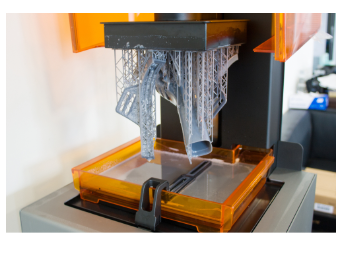
How it Works
- The Tank: The printer has a tank (vat) filled with liquid photopolymer resin (a plastic that reacts to light).
- The Laser: A UV laser traces the shape of a single layer onto the surface of the resin.
- The Cure: Where the laser hits, the liquid instantly “cures” (hardens) into a solid layer.
- The Build: The build platform moves up (or down), and the laser traces the next layer on top of the previous one until the object is finished.

Key Features
- High Precision: SLA is known for incredible detail and very thin layers, making it much smoother than standard FDM (filament) printers.
- Smooth Finish: The layers are so thin that they are often invisible to the naked eye.
- Common Uses: It is widely used for jewelry design, dental models (like clear aligners), and intricate prototypes.
Post-Processing
Unlike some other types of printing, SLA parts require extra steps:
- Washing: Parts must be rinsed in alcohol (IPA) to remove sticky leftover resin.
- Curing: Parts are often placed in a UV “oven” to fully harden and reach their maximum strength.
Digital Light Processing (DLP)
DLP or Digital Light Processing refers to a method of printing that makes use of light and photosensitive polymers. While it is very similar to SLA, the key difference is the light source. DLP utilizes other light sources like arc lamps. DLP is relatively quick compared to other 3D printing technologies.
Digital Light Processing (DLP) is a high-precision, vat-polymerisation 3D printing technology that uses a digital light projector to cure liquid photopolymer resin layer by layer. Unlike traditional laser-based Stereolithography (SLA) which traces lines with a single laser point, a DLP printer flashes an image of an entire cross-sectional layer all at once. This parallel curing process significantly boosts production speed and makes print times dependent on the height of the object rather than its design complexity
How DLP 3D Printing Works
- Model Slicing: A 3D CAD design is sliced into digital 2D layers using specialized software.
- Light Projection: The printer’s internal engine uses a light source (like LEDs or arc lamps) aimed at a Digital Micromirror Device (DMD) chip.
- Pixel Curing: The DMD contains millions of microscopic, tilting mirrors that control individual image pixels. These reflect the UV light pattern through a transparent window at the bottom of the resin vat, curing the layer instantly.
- Z-Axis Progression: The build platform lifts incrementally, allowing fresh liquid resin to flow underneath before the next layer is projected.
- Post-Processing: The finished model is detached, rinsed in Isopropyl Alcohol (IPA) to clear away uncured liquid, and fully hardened inside a UV curing chamber.
Continuous Liquid Interface Production (CLIP)
The process is carried out by projecting UV images in continuous sequence. During the development stage, images are fed into the system using a digital light projector via an oxygen permeable UV transparent screen. This process takes place beneath a liquid resin bath. CLIP normally creates uncured resin between the object and window by controlling the oxygen flux. The thin layer of uncured resin is called the dead zone.
Continuous Liquid Interface Production (CLIP)—commercialized primarily by Carbon as Digital Light Synthesis (DLS)—is a proprietary vat-polymerization 3D printing technology that grows solid objects continuously from a pool of liquid resin.
Unlike traditional SLA or DLP printing, which relies on a slow, mechanical layer-by-layer peeling process, CLIP eliminates distinct layers altogether. This allows parts to be printed up to 25 to 100 times faster while producing smooth surfaces and completely isotropic mechanical properties.
The Core Technology: How CLIP Works
The continuous speed of CLIP relies entirely on a unique, tunable photochemical process rather than mechanical step-movements.
Material Jetting – 3d printer
In this process, material is applied in droplets through a small diameter nozzle, similar to the way a common inkjet paper printer works, but it is applied layer-by-layer to a build platform and then hardened by UV light.
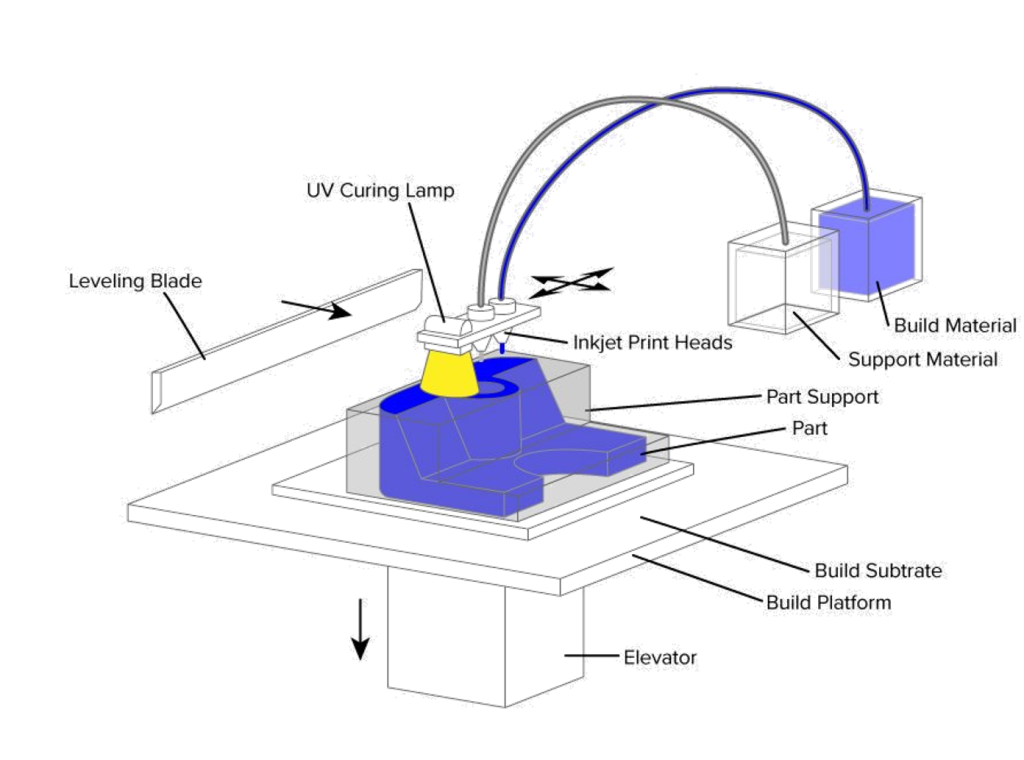
Material Jetting (MJ) is an additive manufacturing process that operates very similarly to a standard 2D inkjet document printer. However, instead of jetting ink onto paper, a Material Jetting printer dispenses droplets of liquid photopolymer resin from hundreds of tiny nozzles onto a build platform, instantly curing them with an attached ultraviolet (UV) light source.
Because the print head deposits material point-by-point, Material Jetting stands out as the most precise and visually realistic form of 3D printing available today.
How Material Jetting Works
- Droplet Deposition: The print head moves across the X-Y build axis and sprays hundreds of microscopic droplets of photopolymer resin precisely where needed.
- Instant UV Curing: A UV light source attached to the moving print head passes over the freshly deposited liquid droplets, instantly solidifying them.
- Z-Axis Lowering: Once a layer is fully jetted and cured, the build platform moves down by a fraction of a millimeter (typically between 16 to 32 microns), and the process repeats.
- Support Dissolution: Material Jetting requires a separate support material to handle overhangs and complex geometries. This support resin is jetted simultaneously but is designed to be easily dissolved or washed away with water post-print.
Key Advantages of Material Jetting
- Full-Color & Multi-Material Printing: It is one of the very few 3D printing technologies capable of mixing multiple colors (CMYK) and materials (flexible and rigid) within the exact same print run, achieving realistic prototypes.
- Exceptional Dimensional Accuracy: Capable of printing layers as thin as 16 microns, it yields incredibly smooth surfaces with virtually invisible layer lines.
- No Shrinkage or Warping: Because the photopolymer resin is fully cured instantly upon deposition, there is negligible cooling shrinkage, leading to highly predictable and accurate parts.
Popular Applications and Brands
- Prototyping Medical & Anatomical Models: Surgeons use Material Jetting to print highly accurate, multi-colored organ replicas from patient scans to practice complex surgeries before entering the operating room.
- Visual Consumer Prototypes: Designers create realistic product prototypes that look and feel identical to final mass-produced goods, complete with clear plastics, rubber gaskets, and branding text.
- Industry Leaders: Stratasys dominates this space with their proprietary PolyJet technology (such as the J-series printers), alongside 3D Systems with their MultiJet Printing (MJP) lineup.
https://shorturl.fm/hvwNV